1819...
Birth of Charles-Frederic Selmer. Like his father Jean-Jacques, and grandfather, Johann Jakobus Selmer (b. 1749), he too will become Bandmaster in the army.
1840...
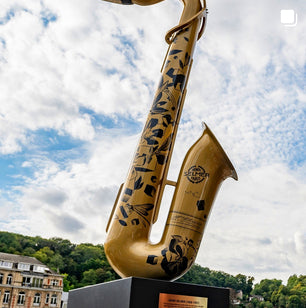
In 1840, Adolphe Sax (born in Dinant, Belgium on November 6, 1814, died in Paris on February 7, 1894) designed a low register instrument which he named the « Saxophon ». He planned to present his new instrument in 1841 to the exhibition committee of the Belgium Industry Fair.
1880...
Henri Selmer - son of Charles Frederic, deceased in 1878 - graduates from the Paris Conservatory (clarinet class of Mr Leroy). He is 22 when he enters the Republican Guard Orchestra. He will play successively as first clarinetist in the Lamoureux concerts, with Benjamin Godard and at the Opera.
1885...
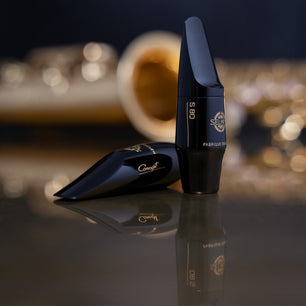
Creation of the Selmer Paris company: Henri Selmer begins manufacturing reeds and mouthpieces.
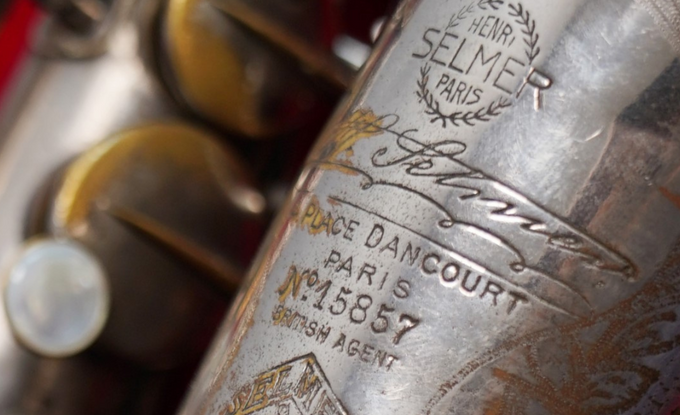
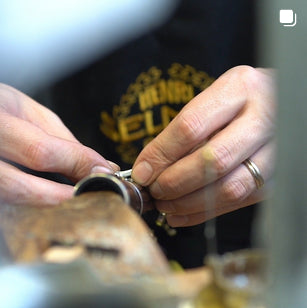
From 1898, with the help of one workman, Henri Selmer starts manufacturing clarinets and settles his workshop at 4 place Dancourt, Paris.
The same year his younger brother, Alexandre (b. 1864), joins the Boston Symphony Orchestra as a clarinetist, remaining until 1901.
1900...
Henri wins his first Bronze Medal in the Paris Exhibition. The same year, he starts to do business in Great Britain with M. Gomez, a local agent.
1904
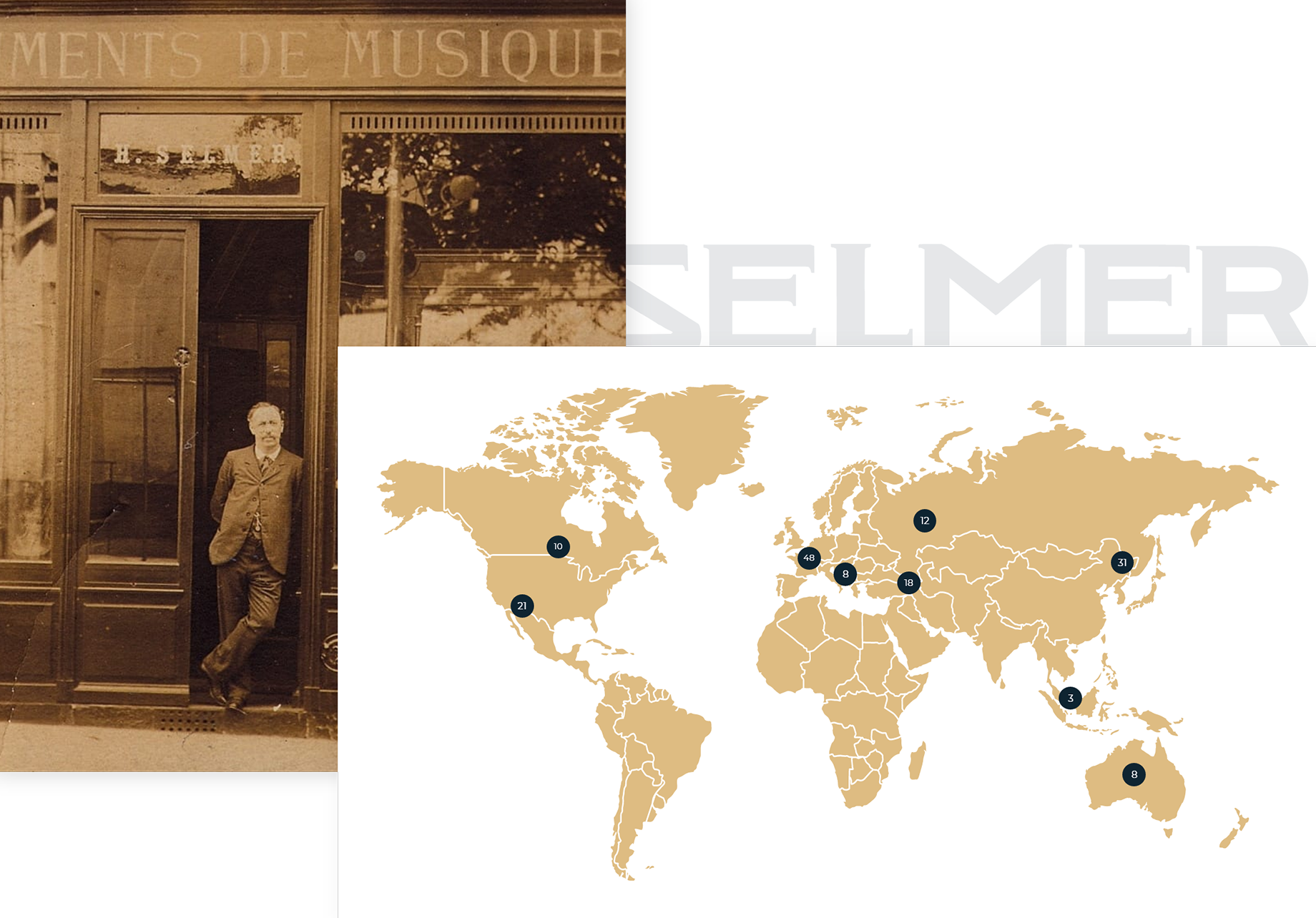
Henri and Alexandre Selmer in the workshop, place Dancourt, Paris.
The Selmer Paris clarinets are presented for the first time at the International Saint Louis Fair (USA), where Henri wins a Gold Medal.
At this period, Alexandre Selmer, Henri's brother, has been Principal clarinet in the Cincinnati Symphony Orchestra for two years. From 1903, he plays the clarinets his brother is manufacturing in France. This will strongly contribute to the development of their sales in the US.
1905...
Paul Lefèvre and his son Henri, who had been working for Maison Robert (a clarinet manufacturer), join Henri Selmer's team.
Henri takes over the Barbier Company (a flute manufacturer, rue du faubourg Saint Denis, in Paris).
The following year, Alexandre officially establishes himself in New York USA, where he starts selling the Selmer Paris clarinets. This first structure will later become the H&A Selmer (USA) company.
1908
Alexandre Selmer joins the New York Philharmonic Orchestra as first clarinetist. There, he has the opportunity to play under the conductor Gustav Mahler.
He set up a shop in New York, in the 86th Street and takes on one of his students, George Bundy, to assist him.
1910...
The 1910 catalogue, one of the very first Selmer Paris catalogues, offers a great variety of instruments and mouthpieces.
p 1-5 : presentation of the company
p 6-10 : the clarinets
p 11-41: the flutes, saxophones and accessories
p 42-49 : methods and scores
Maurice Lefèvre, Paul Lefèvre’s second son, joins the Selmer Paris team.
Alexandre, after having opened his first shop in the United States, decides to return to France, entrusting the management to one of his students, George Bundy.
1912...
Opening of the Gaillon factory (Eure), which employs around 40 workers.
The following year the Paris workshop is expanded and the manufacturing means restructured.
1922
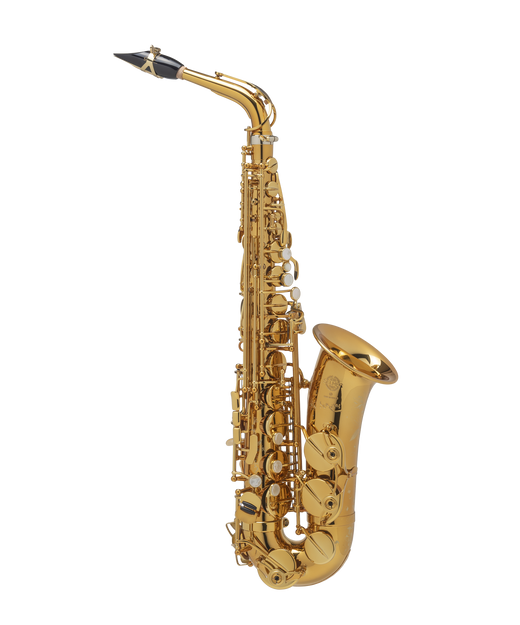
On the 31st of December, 1921, the first Selmer saxophone is finished - a "Series 1922" alto.
The first Selmer saxophones are produced under the name "Series 22".
The "Series 22" makes way for the "Model 22". The whole family is offered, including the "C Melody" tenor saxophone.
François Combelle, saxophonist with the Republican Guard, is a saxophone tester for Selmer (until after the war).
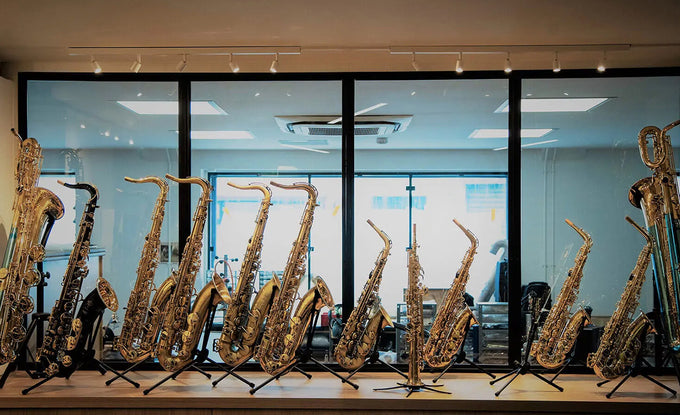
Selmer then counts 50 instrument makers who manufacture 30 saxophones per month.
1923...
1926
A new logotype "Henri Selmer Paris" is adopted : the laurel wreath replaces the lyre. Engraved on all Selmer Paris instruments, this original logo is still used today as the seal of authenticity for the original "Henri Selmer Paris".
Saxophone "Model 26" comes out.
Around 136 workmen work at Selmer.
1927
Metal clarinette comes out.
Grand prize at the International Exhibition of Geneva, for the production as a whole.
1928
Creation of the company "H.Selmer & Co", in S.A.R.L. form
"Model 28" comes out
The catalogue offers a large range of instruments made by Selmer, including the clarinets and bassoons...
... also in the catalogue: flutes, saxophones, english horns andoboes.
Creation of Selmer–Canada.
1929
1930
1932
1933
Release of the "Armstrong" trumpet model later known as "Balanced", and of the model Harry James.
1934
Release of the "Radio Improved" saxophone.
Maurice Selmer enters Selmer Editions.
1936
Selmer Paris revolutionizes the saxophone with a new model which will be called "Balanced Action".
The 1936 catalogue reflects Selmer's development, in terms of new techniques as well as in versatility of expertise :Presentation of clarinets, oboes, english horns and bassoons
Presentation of flutes and saxophones
Presentation of brass
France encounters social troubles and the factory is occupied.
Death of Maurice Lefèvre.
1937...